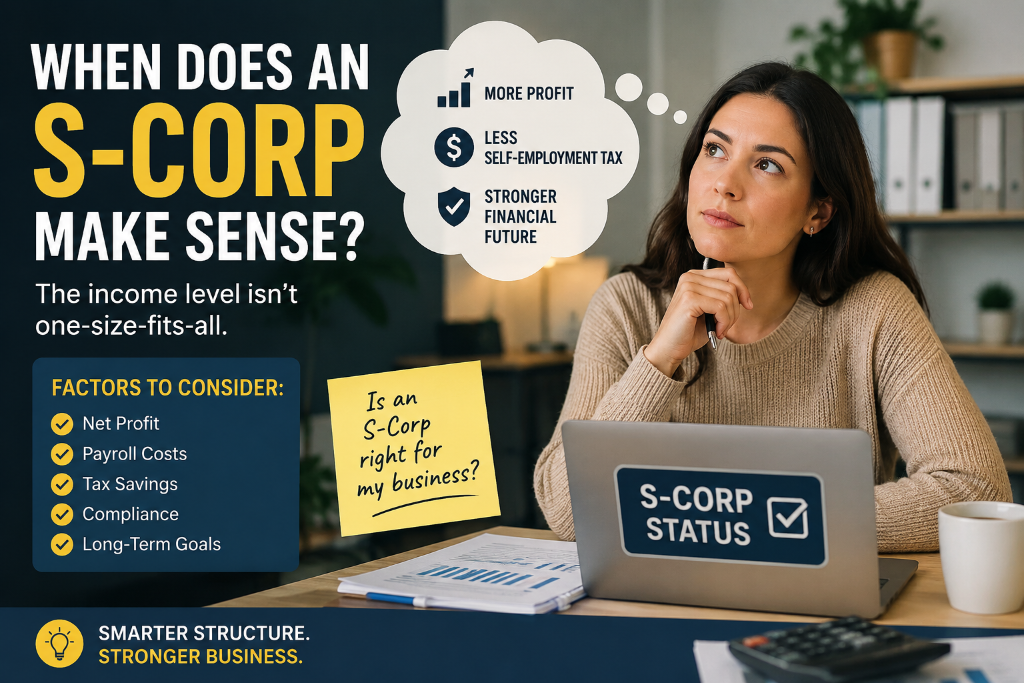
At What Income Level Does It Make Financial Sense for a Freelancer to Switch to an S-Corp?
One of the most common questions freelancers, consultants, real estate professionals, and self-employed business owners ask is:
"How much money do I need to make before an S-Corp actually saves me money?"
The answer may surprise you.
The truth is that there is no magic number. While many accountants throw around figures like $40,000, $50,000, or $75,000 of profit, the real answer depends on much more than income alone.
Let's break it down.
First, Understand Why People Choose an S-Corp
A sole proprietor or single-member LLC pays self-employment tax on all business profits.
Self-employment tax is currently:
- 12.4% Social Security
- 2.9% Medicare
For a combined rate of approximately 15.3% on eligible earnings.
An S-Corp changes the way you pay yourself.
Instead of all profit being subject to self-employment tax, you pay yourself a reasonable salary through payroll and may take remaining profits as distributions.
That difference is where potential tax savings come from.
The Real Question Isn't Revenue
Many business owners focus on revenue.
Revenue doesn't matter.
Profit matters.
Consider these examples.
Freelancer A
- Revenue: $150,000
- Expenses: $120,000
- Net Profit: $30,000
An S-Corp probably doesn't make sense.
Freelancer B
- Revenue: $80,000
- Expenses: $15,000
- Net Profit: $65,000
An S-Corp may make perfect sense.
The decision is based on what's left after business expenses.
Where Most S-Corp Savings Begin
In practice, many tax professionals begin evaluating S-Corp eligibility when profits consistently exceed:
$40,000 - $50,000
At this level:
- Payroll costs become manageable
- Tax savings begin appearing
- Compliance costs may still outweigh savings for some businesses
This is often the gray zone.
The Sweet Spot
For many freelancers and consultants, the strongest S-Corp opportunities begin around:
$60,000 - $100,000+ of annual net profit
At this range:
- Potential payroll tax savings become meaningful
- Additional compliance costs are easier to absorb
- The structure can support retirement planning and long-term tax strategy
This is where many self-employed professionals start seeing clear financial benefits.
Example
Suppose a consultant earns:
- Net Profit: $100,000
A reasonable salary might be:
- W-2 Salary: $60,000
- Distributions: $40,000
The salary remains subject to payroll taxes.
The distribution portion generally avoids self-employment tax treatment.
The result can be thousands of dollars in annual tax savings.
When an S-Corp Usually Doesn't Make Sense
An S-Corp may not be the best choice if:
- Your profits fluctuate dramatically
- Net income is under $40,000
- You are still validating your business model
- You do not want payroll requirements
- You dislike additional bookkeeping and compliance
Remember:
An S-Corp is not a tax deduction.
It is a tax strategy that creates additional responsibilities.
The Hidden Costs Nobody Talks About
Business owners often focus only on tax savings.
But S-Corps also require:
- Payroll processing
- Quarterly payroll filings
- Annual Form 1120-S
- Schedule K-1 preparation
- State compliance requirements
- Reasonable compensation analysis
These costs should always be included in the decision.
The Biggest Mistake Business Owners Make
Many online videos suggest:
"Pay yourself $20,000 salary and take everything else as distributions."
That can create serious IRS issues.
The IRS expects shareholder-employees who actively work in the business to receive reasonable compensation for services provided.
An aggressive salary strategy can eliminate savings very quickly if challenged.
Our Rule of Thumb
At Hive Tax Book, we generally recommend evaluating an S-Corp when:
- Business profits consistently exceed $50,000
- The owner expects continued growth
- The business can support payroll
- Tax savings exceed compliance costs
Most importantly, we look at the entire financial picture:
- Tax savings
- Retirement opportunities
- Mortgage qualification
- Cash flow
- Long-term business goals
Because choosing an S-Corp should never be about taxes alone.
It should be about building a stronger financial foundation for your business.
Related Resources
Before making an S-Corp election, you may also find these resources helpful:
- LLC vs S-Corp: What's the Difference?
- How to Form an LLC in Texas
- Mortgage Readiness for Self-Employed Borrowers
- Business Operating Center Resources
- S-Corp Compliance Check-In
Need Help Determining if an S-Corp Makes Sense?
Every business is different.
A real estate agent earning $80,000 may have a completely different answer than a consultant earning $80,000.
That's why we perform an S-Corp Analysis Review before recommending any election.
The goal isn't to force an S-Corp.
The goal is to determine whether it actually benefits your situation.
Ready to explore your options? Schedule an S-Corp Analysis Review and let us evaluate your business, tax strategy, payroll considerations, and long-term financial goals.