If you're a business owner, one of the smartest things you can do is start teaching your children how business works early.
In some situations, that education can also create legitimate tax planning opportunities when structured properly.
This summer, many business owners are looking for ways to help their children or grandchildren earn money, learn responsibility, and develop real-world skills before entering adulthood.
Inside our own business, we recently created an official offer letter and onboarding process for a child working in the company for the summer.
The process started with paid training focused on practical business skills, including:
- Typing and keyboard proficiency
- Gmail and professional communication
- Internet research and organization
- Digital workflow systems
- Responsible use of AI tools like ChatGPT
After training, work responsibilities increased alongside compensation tied to actual duties performed and documented hours worked.
That structure matters.
Many business owners hear about "hiring your kids" online, but what often gets overlooked is what the IRS actually expects.
The IRS expects:
- Legitimate, documented work
- Reasonable compensation for the duties performed
- Age-appropriate responsibilities
- Organized payroll and work records
This is not about creating fake deductions.
It is about creating real work opportunities while operating your business intentionally and professionally.
How the Strategy Works
Here is a simplified example.
Assume a business owner pays their child $8,000 over the course of the year for legitimate work performed inside the business.
Instead of that $8,000 remaining as taxable business profit:
- The business deducts the wages as an ordinary business expense
- Taxable income decreases
- Self-employment tax exposure may decrease
- Overall family tax positioning may improve
For qualifying sole proprietors and certain single-member LLCs, children under age 18 may also qualify for exemptions from:
- Social Security taxes
- Medicare taxes
- Federal unemployment taxes, also known as FUTA
That can be significant because payroll taxes alone can normally equal 15.3%.
Meanwhile, depending on total income and filing requirements, the child may owe little to no federal income taxes due to the standard deduction.
In many situations, the combined result may include:
- Reduced taxable business income for the parent
- Legitimate documented income for the child
- More money retained overall by the family
- Valuable real-world work experience for the child
Why Documentation Matters
One of the biggest mistakes business owners make when using this strategy is failing to maintain proper documentation.
Common documentation gaps include:
- No work logs or time records
- No duties tracked or described
- No payment records or pay stubs
- No reasonable compensation analysis
If the strategy is being used, documentation is not optional.
Documentation is what helps support the deduction.
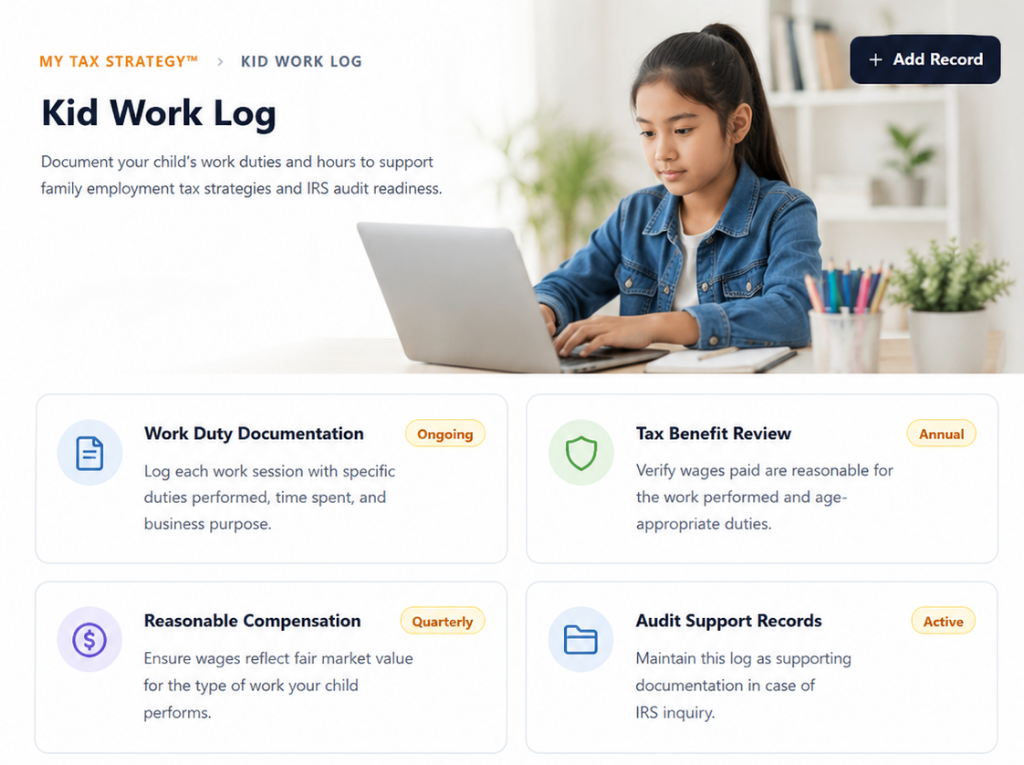
That is why Hive Tax Book includes the Kid Work Log inside My Tax Strategy.
The system allows business owners to:
- Track dates worked
- Log hours performed
- Document specific duties completed
- Maintain supporting notes and context
- Organize audit-support records in one place
The goal is to help business owners maintain cleaner documentation practices while staying operationally organized throughout the year, not just at tax time.
The Bigger Value
The tax savings are helpful.
But the bigger value may be what your child gains along the way.
Working inside a real business, even in a limited capacity, can help children develop:
- Responsibility and follow-through
- Confidence in a professional environment
- Communication and organizational skills
- Familiarity with technology and AI tools
- An early understanding of how business systems work
- Financial literacy that many adults never received
Even simple business tasks can create meaningful development opportunities, including:
- Organizing documents and files
- Helping with social media content
- Email management and correspondence
- Data entry and spreadsheet basics
- Scanning and filing receipts
- Assisting with content or research projects
These are real skills.
For many children, this becomes their first real introduction to how a professional environment operates.
Final Thought
Hiring your children in your business is not a tax trick.
When structured properly, documented correctly, and operated professionally, it can become both a legitimate business strategy and a meaningful opportunity to prepare the next generation with valuable skills early in life.
The key is doing it correctly with real work, reasonable pay, and organized records to support it.