Just the other day, someone asked us through Ask Hive Tax Book:
"How much can I contribute to a Solo 401(k) as a freelancer?"
Let's answer the question directly.
If you're a freelancer operating as an LLC and your business earns $80,000 of net income, you may be able to contribute approximately $35,000 to $38,000 into a Solo 401(k), depending on your age and the applicable IRS limits.
Most freelancers are surprised when they hear that.
Why?
Because they assume retirement plans are only for large businesses or high-income earners.
The reality is that the Solo 401(k) is one of the most powerful tax and retirement planning tools available to self-employed individuals.
How Does It Work?
As a freelancer, you're both the employee and the employer.
That allows you to contribute in two ways.
First, you can make an employee contribution.
Second, your business can make an employer contribution.
When combined, those contributions can become substantial.
The more profitable your business becomes, the greater the retirement planning opportunity.
What Does That Look Like?
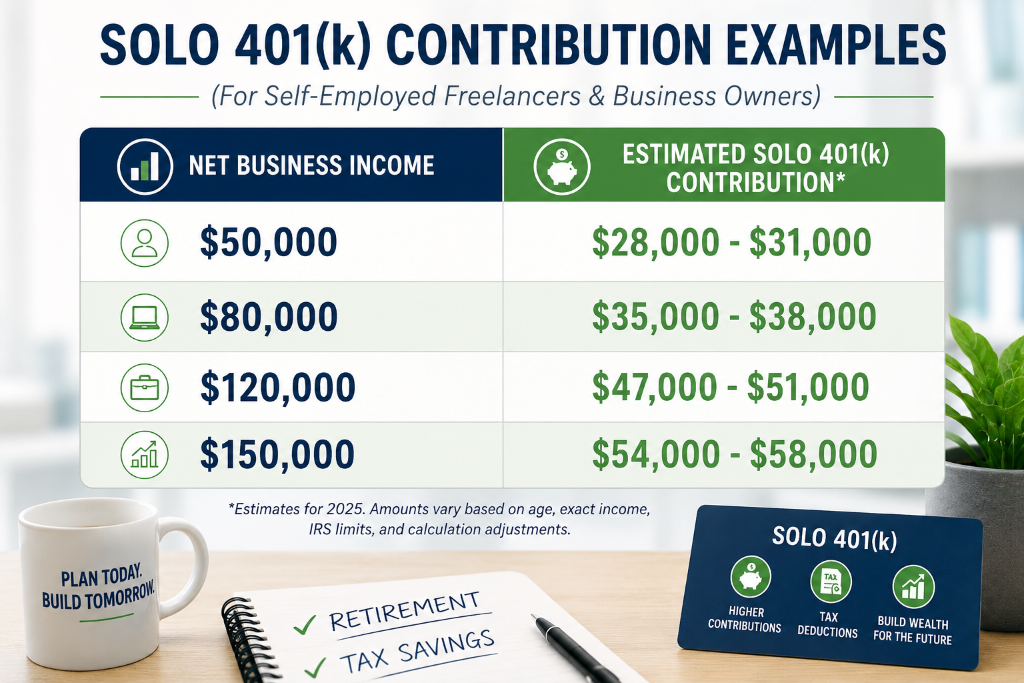
Let's look at a few examples.
| Net Business Income | Estimated Solo 401(k) Contribution |
|---|---|
| $50,000 | $28,000 – $31,000 |
| $80,000 | $35,000 – $38,000 |
| $120,000 | $47,000 – $51,000 |
| $150,000 | $54,000 – $58,000 |
These are examples for illustration purposes. Actual amounts vary based on age, exact income, IRS limits, and calculation adjustments.
For many freelancers, the bigger surprise isn't how much they can contribute.
It's how much they're currently leaving on the table.
What If I'm an S-Corporation?
This is where things get interesting.
Let's assume your business earns $150,000.
As an LLC, your retirement contribution calculation is generally based on your self-employment income.
Now let's assume you elected S-Corporation status.
You pay yourself:
- W-2 Salary: $70,000
- Distribution: $80,000
Many business owners assume they can make retirement contributions based on the full $150,000.
That's not usually how it works.
For Solo 401(k) purposes, employer contributions are generally based on W-2 wages rather than distributions.
In other words, your retirement contribution opportunity may be lower than the LLC owner.
So Does That Mean an LLC Is Better?
No.
This is where many business owners focus on the wrong number.
An LLC may create larger retirement contribution opportunities.
An S-Corporation may create meaningful self-employment tax savings.
The answer is almost never as simple as choosing the structure with the largest deduction.
The real question is:
Which strategy creates the best overall outcome?
For some business owners, that's an LLC.
For others, it's an S-Corporation.
For many, it's a combination of retirement planning and S-Corp tax savings working together.
A Common Example
Business Owner #1 – LLC
Net Profit: $120,000
Potential Solo 401(k) Contribution: Approximately $47,000 to $51,000
Business Owner #2 – S-Corp
Business Profit: $120,000
W-2 Salary: $60,000
Distribution: $60,000
Potential Solo 401(k) Contribution: Lower than the LLC example because calculations are generally based on wages rather than distributions.
However, the S-Corp owner may save thousands in self-employment taxes.
That's why retirement planning should never happen in a vacuum.
The best strategy considers:
- Retirement goals
- Tax savings
- Cash flow needs
- Future mortgage plans
- Long-term wealth building
Final Thoughts
If you're a freelancer with $80,000 of net income, you may be able to contribute roughly $35,000 to $38,000 into a Solo 401(k).
That's often far more than business owners realize.
The bigger question isn't whether you can contribute.
The bigger question is whether your business structure and retirement strategy are working together.
A Solo 401(k) can be an incredible tool for reducing taxes and building wealth, but the best results happen when retirement planning is coordinated with your overall tax strategy.
Not sure whether a Solo 401(k), SEP IRA, LLC, or S-Corporation strategy makes sense for your situation?
A Tax Strategy Review can help identify opportunities based on your income, business structure, retirement goals, and long-term financial plans.