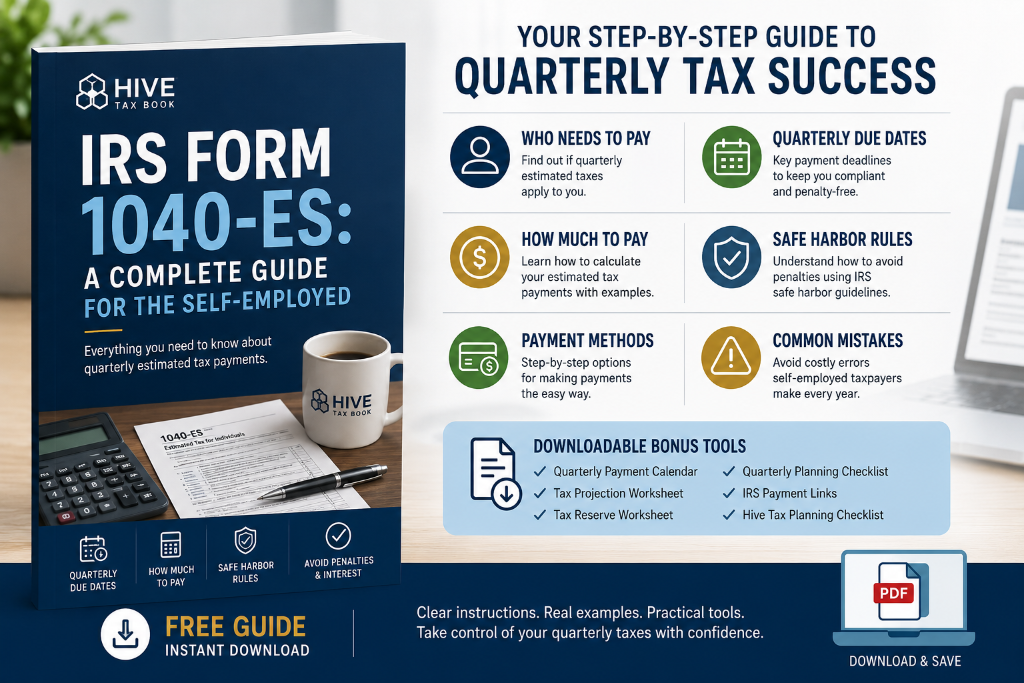
If you're self-employed, nobody is withholding taxes from your income.
That means you may be responsible for making quarterly estimated tax payments throughout the year using IRS Form 1040-ES.
This guide explains:
- Who needs to make estimated tax payments
- How quarterly taxes work
- Payment due dates
- How much to pay
- Common mistakes to avoid
- How freelancers, LLCs, and S-Corps are affected
What Is IRS Form 1040-ES?
IRS Form 1040-ES helps individuals calculate and submit estimated tax payments during the year.
Unlike W-2 employees, self-employed taxpayers generally do not have federal taxes withheld from their income.
Instead, the IRS expects taxes to be paid throughout the year.
Who Needs To Make Estimated Tax Payments?
You may need to make estimated payments if you are:
- Freelancer
- Consultant
- Gig worker
- Real estate agent
- Independent contractor
- Sole proprietor
- Single-member LLC owner
- S-Corporation owner receiving K-1 income
- Investor with significant taxable income
What Happens If I Don't Pay Quarterly Taxes?
Potential consequences include:
- IRS penalties
- Interest charges
- Unexpected tax balances
- Cash flow challenges at filing time
Important: You may still receive a refund even if penalties apply. The penalty is calculated separately from your refund or balance due.
Quarterly Due Dates
| Income Period | Due Date |
|---|---|
| Jan 1 – Mar 31 | April 15 |
| Apr 1 – May 31 | June 15 |
| Jun 1 – Aug 31 | September 15 |
| Sep 1 – Dec 31 | January 15 |
Note: The IRS does not divide quarters evenly. Many taxpayers are surprised by this — the second "quarter" only covers two months, while the fourth covers four.
How Much Should I Pay?
Simple answer: it depends.
Factors include:
- Expected income
- Business deductions
- Filing status
- Other household income
- Prior year tax liability
The goal is to pay enough throughout the year to avoid underpayment penalties while preserving cash flow for your business.
Example: Freelancer
Revenue: $100,000
Expenses: $20,000
Net Profit: $80,000
The estimated federal tax obligation on $80,000 of net self-employment income may require meaningful quarterly payments throughout the year — covering both income tax and self-employment tax.
Every situation differs. This example is educational only.
Example: LLC Owner
Revenue: $150,000
Expenses: $50,000
Net Profit: $100,000
The owner generally calculates estimated payments based on expected annual tax liability, taking into account deductions, retirement contributions, and other planning strategies that may reduce the taxable amount.
Example: S-Corporation Owner
Business Profit: $150,000
Salary: $70,000
Distribution: $80,000
Key point: Payroll withholding on the W-2 salary may cover part of the owner's tax obligation. However, additional estimated payments may still be required — especially on K-1 income flowing from the S-Corporation.
Safe Harbor Rules Explained
One of the most misunderstood areas of estimated taxes.
Generally speaking, many taxpayers can avoid underpayment penalties by paying enough during the year based on prior-year tax obligations.
Common safe harbor thresholds:
- Pay at least 100% of last year's tax liability, or
- Pay at least 90% of the current year's tax liability
(Higher-income taxpayers may need to pay 110% of the prior year's liability.)
"Safe Harbor protects against penalties — not necessarily against owing taxes at filing time."
How To Make Payments
The IRS offers several payment methods:
- IRS Direct Pay — free, no registration required
- EFTPS (Electronic Federal Tax Payment System) — free, requires registration
- IRS Online Account — pay directly through your IRS account
- Tax software — many platforms support estimated payment scheduling
- Professional tax preparer — your tax professional can coordinate payments
Common Mistakes
Waiting Until Tax Season
The most common mistake. Quarterly taxes are due throughout the year — not just in April.
Spending Tax Money
Treat tax reserves as untouchable. Set aside a portion of every payment you receive.
Ignoring Safe Harbor Rules
Not understanding safe harbor can create unnecessary penalties, even when you pay at filing time.
Forgetting State Taxes
Federal estimated taxes are not the only obligation. Most states have their own estimated tax requirements.
Not Adjusting During the Year
Income changes. If your business grows significantly, your estimated payments should increase accordingly.
Quarterly Tax Planning Checklist
Use this checklist before each quarterly due date:
- Review year-to-date income
- Review business expenses
- Update profit projections
- Calculate estimated taxes
- Submit payments on time
- Save confirmation receipts
- Review retirement contribution opportunities
- Review tax strategy opportunities
Self-Employed Tax Savings Opportunities
Before calculating estimated taxes, make sure you're accounting for all available deductions and strategies:
- Solo 401(k) — Reduce taxable income while building retirement wealth
- SEP IRA — Flexible retirement contributions for self-employed individuals
- S-Corporation Election — May reduce self-employment tax obligations
- Home Office Deduction — Deduct a portion of home expenses used for business
- Accountable Plan — Reimburse business expenses tax-free through your entity
- Section 179 — Immediately deduct qualifying equipment purchases
- Hiring Your Children — Pay reasonable wages to minor children and shift income
Each strategy can affect how much you owe in estimated taxes — which is why planning before each quarter matters.
Final Thoughts
Estimated taxes are not optional for most self-employed business owners.
But with the right planning, they don't have to be stressful.
The key is understanding your obligations, setting aside reserves consistently, and making payments on time.
If your income changes during the year — up or down — revisit your estimates.
The goal isn't just to avoid penalties.
The goal is to build a tax strategy that works with your cash flow, retirement goals, and long-term financial plan.
Need help calculating your quarterly estimated taxes?
Hive Tax Book members gain access to tax planning resources, calculators, strategy guides, and educational tools designed specifically for self-employed business owners.