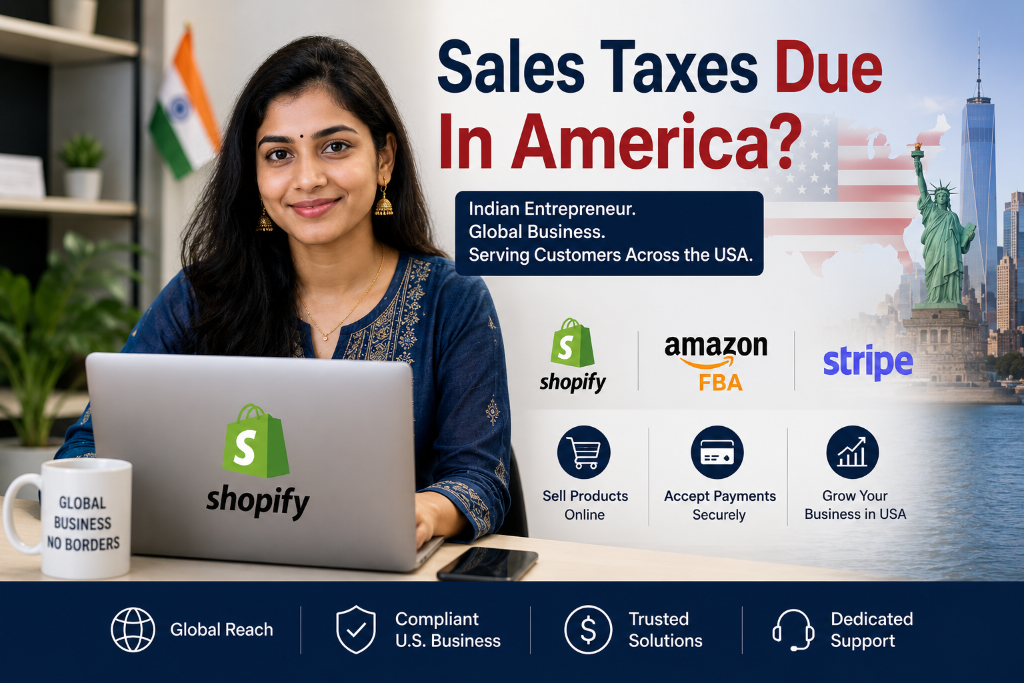
If you own a U.S. business but live outside the United States, there is one mistake that can become very expensive:
Assuming that because you are not a U.S. citizen or resident, U.S. sales tax rules do not apply to you.
Every year, foreign entrepreneurs form Wyoming LLCs, Delaware LLCs, and other U.S. entities to operate online businesses, sell products, provide services, or run e-commerce stores. Many of these owners correctly learn about IRS Form 5472 requirements but completely overlook state sales tax obligations.
The reality is simple:
Sales tax generally does not care about your nationality.
Instead, sales tax laws focus on where your customers are located, where your inventory is stored, and whether your business has created a sufficient connection—known as nexus—with a state.
The Most Common Misunderstanding
Many foreign business owners ask:
"I'm not a U.S. citizen. Why would I owe sales tax?"
The better question is:
"Have I created sales tax nexus in a state?"
Sales tax is a state-level compliance issue. Your passport, citizenship, and country of residence usually do not determine whether you must register for sales tax.
Your business activities do.
Federal Tax and Sales Tax Are Not the Same Thing
One of the biggest sources of confusion is that business owners often combine multiple compliance topics into one.
For example, a foreign-owned LLC may have:
- IRS Form 5472 filing requirements
- No federal income tax due
- State annual report requirements
- Sales tax registration requirements
All at the same time.
These are separate compliance systems with different rules.
Just because a business does not owe federal income tax does not automatically mean it has no sales tax obligations.
What Creates Sales Tax Nexus?
Sales tax obligations typically begin when a business establishes nexus with a state.
Nexus can be created in several ways.
Physical Nexus
Physical nexus often exists when a business has:
- Employees
- Contractors
- Office space
- Warehouses
- Inventory
- Retail locations
inside a state.
For example, if inventory is stored in a state, that state may consider your business to have nexus regardless of where you personally live.
Economic Nexus
Economic nexus became much more important after the Supreme Court's Wayfair decision.
Today, many states require businesses to register and collect sales tax after crossing certain sales thresholds.
Common triggers include:
- Annual sales exceeding a state's threshold
- Large transaction volumes
- Significant economic activity within the state
The exact rules vary by state.
Example: Foreign-Owned Shopify Store
Imagine a business owner living in Thailand.
They form a Wyoming LLC and sell products through Shopify.
The owner assumes:
"I'm not American, so U.S. sales tax does not apply."
However, if customers are located in states where nexus thresholds are exceeded, sales tax obligations may arise regardless of the owner's nationality.
The question is not where the owner lives.
The question is where the business activity occurs.
Example: Amazon FBA Sellers
Amazon FBA is one of the most common areas where foreign-owned businesses encounter unexpected sales tax issues.
A business owner may live in:
- Germany
- France
- Brazil
- Thailand
- United Kingdom
Yet Amazon may store inventory in multiple U.S. states.
When inventory is stored in a state, nexus may be created.
Many sellers never realize they have established connections with multiple states simply because inventory is being moved and stored through Amazon's fulfillment network.
Example: Service-Based Businesses
Service businesses require a different analysis.
Consider a marketing consultant living in Colombia who owns a Wyoming LLC and serves U.S. clients.
The relevant questions become:
- Are the services taxable in the customer's state?
- Has economic nexus been established?
- Does the state tax those particular services?
Service taxation varies significantly by state.
The answer is rarely determined by where the owner lives.
Four Questions Every Foreign Business Owner Should Ask
1. What Am I Selling?
Different states treat the following differently:
- Physical products
- Digital products
- SaaS subscriptions
- Memberships
- Consulting services
- Online courses
2. Where Are My Customers Located?
Sales tax obligations are often tied to customer locations and nexus rules.
3. Do I Have Inventory Anywhere?
Inventory stored through:
- Amazon FBA
- Walmart Fulfillment
- Third-party warehouses
may create nexus.
4. Have I Crossed Any State Thresholds?
Many businesses trigger economic nexus without realizing it simply because revenue grows over time.
The Bottom Line
Being a foreign business owner does not automatically exempt you from U.S. sales tax obligations.
Sales tax generally focuses on:
- Business activity
- Customer locations
- Inventory locations
- Nexus thresholds
—not citizenship or residency.
If you own a foreign-owned U.S. business, understanding your sales tax exposure is just as important as understanding your federal filing obligations.
Ignoring sales tax because you live outside the United States can lead to compliance issues that are far more expensive to fix later.
Need Help Reviewing Your Sales Tax Exposure?
Hive Tax Book offers compliance-focused resources and advisory services to help business owners understand potential state tax obligations, nexus issues, and reporting requirements.
Because when it comes to sales tax, the question usually isn't where you live.
It's where your business has created nexus.